1

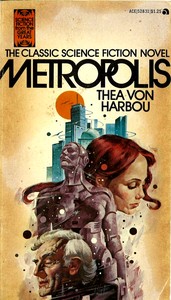
Metropolis — Background and Themes
(0 User reviews)
378
Project Gutenberg
2024
Not confirmed
Science fiction
Readers of public-domain and historical texts
Project Gutenberg digital edition
en
Edition facts
Words
76,379
Reading time
333 min
Text sections
26
The source record for Metropolis — Background and Themes measures this digital text at 76,379 words, 5 hr 33 min estimated reading time, and 26 detected text sections.
The text analysis averages about 12.7 words per sentence, while the detected sections provide another way to judge how the source is divided.
Project Gutenberg metadata also associates the work with “Science fiction,” connecting these edition facts with the source record’s subject description.
Source:
Project Gutenberg record #73727
An editorial note examining the structural and imagistic patterns in Thea von Harbou's Metropolis, focusing on the interplay of cosmic and industrial imagery, the repetition of numbers and signs, and the motif of isolation within a vast cityscape.
Read the complete public-domain text at its original source.
Read on Project GutenbergThea von Harbou's Metropolis opens not with a cityscape but with an organist's vision: Freder, playing the great organ, perceives the vault of heaven in lapis lazuli, the zodiac in gold, and a dance of stars. This cosmic overture immediately establishes a pattern of sensory overload and symbolic layering that recurs throughout the novel. The organ itself becomes a reef in a sea, and the music dissolves the room into nothing—a technique von Harbou uses repeatedly to blur the boundaries between interior experience and external reality.
Cosmic and Industrial Imagery
The novel's imagery oscillates between celestial grandeur and industrial mechanization. In the opening chapter, Freder's music conjures a universe of stars and planets, but this cosmic vision is soon juxtaposed with the "whirl of light" of Metropolis itself. Von Harbou describes the city as "dancing in a whirl of light," a phrase that echoes the earlier dance of the stars, suggesting a parallel between the natural cosmos and the man-made metropolis. Later, Freder stands on a balcony, his eyes "staring across Metropolis" but not seeing it—his gaze is blind, as if the city has become a substitute for the heavens. This interplay is reinforced by the recurring image of the "shining word" Phantasus circling a roof, a mechanical counterpart to the zodiac's eternal motion.
The Persistence of Numbers and Signs
Von Harbou uses numbers and signs as structural motifs that invade the protagonist's consciousness. In the excerpt, Freder is haunted by the sequence "90.... 7.... 7...." that appears on a building, repeating with mechanical insistence. The numbers "flame up, sparkle, go out" inside him, becoming an internalized pattern he cannot escape. This repetition mirrors the novel's own structural use of chapters and sections, but more importantly, it reflects a world where human perception is colonized by the city's signage. The numbers are described as "obtrusive" and "penetrating," and Freder's struggle to interpret them—"What did that mean?"—underscores a theme of incomprehensible communication in a hyper-mediated environment.
Isolation and the Wall of Loneliness
A recurring image in the excerpts is the "wall of loneliness" that surrounds Freder. Von Harbou describes the balcony railing as an "insuperable wall" washed by the "lustrous surf" of Metropolis. This metaphor of a barrier made of light and sound recurs when Freder's father, Joh Fredersen, approaches him: Freder's hand gives no answer, his mouth gives no answer. The physical touch of his father's hand on his own yields no response, emphasizing a profound disconnection. Even the city's lights and sounds—the "strong, lustrous surf"—fail to penetrate this wall. Von Harbou extends this isolation to Josaphat, who watches Freder from a rooftop, unable to bridge the gap. The novel thus presents a world where characters are physically proximate but emotionally and communicatively sealed off.
Movement Between Interior and Exterior
Von Harbou structures scenes around abrupt shifts between interior mental states and external cityscapes. Freder's organ playing dissolves the room into a cosmic sea, but later he stands on a balcony, his eyes "blind" to the city below. The narrative moves fluidly from Freder's subjective visions—the organ as a reef, the earth burning—to objective descriptions of Metropolis's lights and crowds. This oscillation is mirrored in the character of Josaphat, who watches Freder from a rooftop, unable to discern his face but reading his isolation from the "pale patch" of his face in the sunset. The novel's structure thus relies on a constant alternation between the inner world of perception and the outer world of the city, with neither fully dominating.
Readers attentive to von Harbou's use of repetition and symbolic imagery will find a novel that operates less as a straightforward narrative than as a series of visual and auditory motifs. The numbers, the circling word Phantasus, and the wall of loneliness are not merely decorative but structural elements that shape the protagonist's experience. Approaching Metropolis as a work of patterned perception rather than plot-driven science fiction may yield a richer understanding of its method.
Reading Metropolis — Background and Themes, I kept noticing how von Harbou returned to certain numbers and signs, as if counting the city’s isolated heartbeats. That same sense of a patterned, monumental world drifted back to me from The German Classics of the Nineteenth and Twentieth Centuries, Volume 01 Masterpieces of German Literature Translated into English. — Reading Companion, where older writers also wrestled with vastness and solitude. Odd, how two distant volumes can share one quiet, recurring echo.
There are no reviews for this eBook.
There are no comments for this eBook.
Reader reflection
What was your reading experience?
Capture what you thought, learned, and would like to remember.
Your progress
0
/
10
2
Was reading this book enjoyable?
3
Would you pass this book on to a friend?
4
How demanding did the text feel?
5
What did you appreciate most?
6
How useful were the ideas in this book?
7
How closely did the book connect with your experience?
8
Was the book moving at the right speed?
9
In one sentence, what did you learn?
10