1

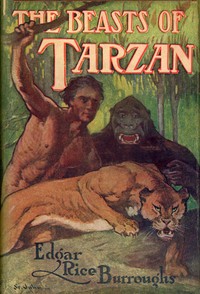
The Beasts of Tarzan — Reading Companion
(0 User reviews)
425
Project Gutenberg
1993
Not confirmed
Tarzan (Fictitious character) -- Fiction; Fantasy fiction; Jungle animals -- Fiction; Adventure stories
Readers of public-domain and historical texts
Project Gutenberg digital edition
en
Edition facts
Words
68,046
Reading time
296 min
Text sections
22
Before opening The Beasts of Tarzan — Reading Companion, the edition data offers a quick orientation: 68,046 words, 4 hr 56 min estimated reading time, and 22 detected text sections.
The text analysis averages about 23.9 words per sentence, while the detected sections provide another way to judge how the source is divided.
Project Gutenberg metadata also associates the work with “Tarzan (Fictitious character) -- Fiction,” connecting these edition facts with the source record’s subject description.
Source:
Project Gutenberg record #85
In this third Tarzan novel, the ape-man is separated from his wife and infant son by the escaped Russian villain Nikolas Rokoff. Stranded on a jungle island, Tarzan must command a menagerie of wild beasts to survive and rescue his family. The narrative shifts between Tarzan's primal resourcefulness and Jane Clayton's ordeal, with a subplot involving a swapped baby and a treacherous native chief.
Read the complete public-domain text at its original source.
Read on Project GutenbergThe third Tarzan novel opens not in the jungle but in Paris, where Lord Greystoke—still called Tarzan by those who know his past—learns that his arch-enemy Nikolas Rokoff has escaped from a French military prison. The news immediately shifts the ape-man's concern from his own safety to that of his wife and infant son in London. This early emphasis on family vulnerability, rather than on Tarzan's physical prowess, sets a different tone from the earlier books. The narrative quickly splits: Tarzan is kidnapped and marooned on a jungle island, while Jane Clayton is taken aboard the Kincaid. The excerpts reveal a story built on separation, mistaken identity, and the strategic use of wild animals as both threat and tool.
A Villain's Escape and a Father's Fear
The opening chapter establishes a domestic anxiety rare in adventure fiction of this era. Tarzan, immaculate in his London attire, is described as “gazing meditatively at the toe of his immaculate boot”—a detail that underscores how far he has come from his feral origins. Yet his first words to D'Arnot are not about revenge but about protecting his family: “Unless I misjudge the man, he would more quickly strike at me through my wife or son.” This is not the Tarzan who fought alone in the first novel; he is now a husband and father, and his enemies know it. Rokoff's escape is not just a plot device but a catalyst that forces Tarzan to confront a new kind of threat—one that targets his emotional attachments rather than his physical survival.
The Beasts as Instruments and Companions
The title The Beasts of Tarzan is literal: Tarzan must command a group of wild animals, including the panther Sheeta and the ape Akut, to survive on a deserted island. The excerpts show him not merely taming these creatures but forming a working alliance with them. When Tambudza warns Tarzan of a plot by Chief M'ganwazam, the conversation reveals that Tarzan's reputation among native peoples is tied to his ability to communicate with beasts. The old woman says, “M'ganwazam has chosen the young men who are to sleep in the hut with you”—a plan to kill Tarzan while he sleeps. Tarzan's response is to slip away into the jungle, using the darkness and his knowledge of animal behavior to evade capture. The beasts are not just props; they are extensions of Tarzan's own hybrid nature, bridging the human and animal worlds.
Jane Clayton's Ordeal and the Swapped Child
Jane Clayton's storyline introduces a cruel twist: she is told her baby has died of fever, only to be presented with a different infant. In a harrowing scene, she confronts the Swede Anderssen, crying, “Where is my baby? … It is not mine. You knew that it was not mine. You are a devil like the Russian.” Anderssen's bewilderment—his blue eyes “stretched in surprise”—suggests he is genuinely ignorant of the substitution. This moment of mistaken identity adds a layer of psychological horror to the physical dangers of the jungle. Jane's maternal instinct is manipulated by Rokoff's schemes, and the narrative forces her to question what she can trust. The baby's crowing and reaching hands eventually break through her despair, but the uncertainty remains: is this child hers or a replacement? The excerpts leave this unresolved, making the reader wait for the full revelation.
Readers familiar with earlier Tarzan novels will notice a shift in focus: the jungle is no longer a solitary proving ground but a stage for family drama and calculated cruelty. Pay attention to how Burroughs uses the beasts—not as mere obstacles but as characters with their own loyalties. The swapped baby subplot, glimpsed only in fragments here, promises a resolution that may test Tarzan's ability to balance his two identities: the civilized lord and the ape-man who commands the wild.
Years of shelving these two side by side taught me something about cunning. Tarzan’s beast-commanding is pure grit, but Lupin’s hollow needle hides a quieter, more civilized trickery. Both men outthink their traps, yet one uses claws, the other keys. I often recall their shared solitude—each hero, ultimately, alone with his cleverness. The Hollow Needle; Further adventures of Arsène Lupin — Inside the Classic feels like a polite echo of that jungle’s wild resourcefulness.
There are no reviews for this eBook.
There are no comments for this eBook.
Reader reflection
Your personal reading reflection
Build a private reading journal entry for this title.
Your progress
0
/
10
2
How did the book work for you overall?
3
Would you encourage someone else to read it?
4
What was the reading difficulty like?
5
Did this book create an emotional response?
6
How understandable was the text?
7
How closely did the book connect with your experience?
8
How useful were the ideas in this book?
9
In one sentence, what did you learn?
10