1

The Green Millennium — Edition Insights
(0 User reviews)
1167
Project Gutenberg
2021
Not confirmed
Science fiction
Readers of public-domain and historical texts
Project Gutenberg digital edition
en
Edition facts
Words
64,206
Reading time
280 min
Text sections
6
The Green Millennium — Edition Insights can be approached with a clearer sense of reading commitment from its source measurements: 64,206 words, 4 hr 40 min estimated reading time, and 6 detected text sections.
The text analysis averages about 14.2 words per sentence, while the detected sections provide another way to judge how the source is divided.
Project Gutenberg metadata also associates the work with “Science fiction,” connecting these edition facts with the source record’s subject description.
Source:
Project Gutenberg record #65482
An editorial note examining Fritz Leiber's word-level choices in The Green Millennium: the contrast between Phil Gish's internal voice and the bureaucratic jargon of the FBL, the use of sensory details to evoke a dystopian mood, and the structural function of the green cat as a plot device rather than a symbol.
Read the complete public-domain text at its original source.
Read on Project GutenbergFritz Leiber opens The Green Millennium with a protagonist whose internal monologue immediately establishes a world of oppressive routine. Phil Gish's morning is described through a series of reflexive actions—'whip-cracking reflexes,' 'jerking on his shorts and sockasins'—that convey a life governed by automatic responses. The prose itself mimics this mechanical quality, with long, clause-heavy sentences that pile up details of a dystopian reality: 'hot and cold wars gushing unpredictably for fifty years like temperamental faucets,' the 'Federal Bureau of Loyalty and Fun Incorporated,' and a president described as 'drunken, hymn-singing.' Leiber's diction here is deliberately hyperbolic, mixing bureaucratic jargon with absurdist imagery to create a tone of weary satire.
Voice and the Bureaucratic Grotesque
The dialogue between FBL agent Greeley and Fun Incorporated's Billig reveals Leiber's ear for power dynamics encoded in speech. Billig's language is deceptively mild—'Who mentioned anything like that?'—while Greeley's responses are clipped and defensive. The negotiation over the green cat becomes a contest of euphemisms: 'protective custody' versus 'pay you in human lives.' Leiber uses the contrast between Billig's 'reflective smile' and Greeley's 'flushed' anger to underscore the moral ambiguity of both sides. The author's choice to have Billig reference 'ways to forget' while glancing at Dora adds a layer of psychological manipulation that is never explicitly stated but felt through the characters' physical reactions.
Sensory Details and Dystopian Texture
Leiber builds his future through small, tactile details rather than exposition. Phil's apartment walls are 'advertisement-covered,' and his morning routine includes 'beard-dissolving cream' and 'sockasins'—brand-name neologisms that feel both familiar and alien. The soundscape is equally specific: Phil hears 'the soft kiss of a door slitting open' and 'faint footsteps drabber in quality than the binaural richness' of the conversation he's eavesdropping on. These sensory cues ground the reader in a world where technology is omnipresent but degraded. The 'Kremlin Newsmoon' orbiting Earth as a satellite vehicle is mentioned in passing, a single detail that implies a global cold war without requiring further explanation.
The Green Cat as Structural Device
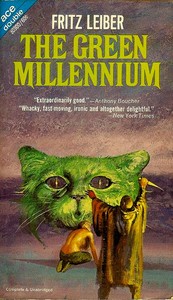
From the excerpts, the green cat functions primarily as a MacGuffin—an object that sets the plot in motion and around which characters negotiate. Phil's initial reaction to the cat is described in terms of emotional relief: 'For the first time in years Phil was happy.' Yet Leiber undercuts this sentiment by immediately having the cat disappear into All Amusements park, a setting described as a 'syndicated playground' catering to 'sadistic and otherwise aberrated' impulses. The cat's color is never explained in the provided text; it is simply presented as an anomaly that disrupts the status quo. The author's restraint in not over-explaining the cat's nature keeps the focus on the human responses it provokes—fear, greed, hope—rather than on the object itself.
Narrative Framing and Unreliable Perception
Leiber employs a close third-person perspective that stays tethered to Phil's limited awareness. The opening paragraph explicitly states that Phil 'didn't enjoy living' in his world, but the narrative voice quickly adopts his vocabulary—'luck-forsaken little guy,' 'poor, miserable clunks'—blurring the line between authorial description and character thought. When Phil feels 'as if this were not a world' of perpetual war, the conditional 'as if' signals that his perception may be unreliable. This technique allows Leiber to present a dystopian setting through a protagonist who is both part of it and alienated from it, creating a tension between the reader's understanding and Phil's filtered experience.
Pacing and the Use of Interruption
The excerpted negotiation scene is structured around interruptions: a phone-light blinks, Moe Brimstine listens 'silently, and kept on listening,' and Phil hears a door open. These breaks in dialogue serve to heighten suspense while also revealing character priorities. Billig's demand for 'the witnesses, delivered into our hands' is immediately countered by Greeley's refusal, but the interruption of the phone call shifts the power balance. Leiber uses these structural pauses to mimic the unpredictability of espionage, where information arrives in fragments. The final line—'You've lost the green cat'—is delivered as a punch, cutting off the negotiation and redirecting the plot without resolution.
Readers attentive to Leiber's prose will find a satirical edge that cuts both ways: the government is as corrupt as the syndicate it opposes, and Phil's passivity is both a survival mechanism and a critique of complicity. The green cat remains an enigma in the excerpts, but its function as a catalyst for conflict is clear. Pay attention to how Leiber uses physical objects—doors, phones, guns—as punctuation marks in his scenes, and how the characters' speech patterns reveal their allegiances. The novel rewards close reading of its word-level choices, which build a world that feels both absurd and uncomfortably plausible.
I kept thinking about how Leiber makes you feel the weight of every word, the way Phil’s quiet thoughts sit against that cold bureaucratic hum. It’s a lot like the lingering unease in The Count’s Millions, where the real story hides in what’s unsaid. That stayed with me. The Count's Millions — Context and Discussion has that same patient, almost secretive pull.
There are no reviews for this eBook.
There are no comments for this eBook.
Reader reflection
Record your reading impressions
A brief reflection can help important ideas stay with you longer.
Your progress
0
/
10
2
Did this book hold your interest?
3
Would you recommend this book to another reader?
4
How much effort did this book require?
5
Which part made the strongest impression?
6
How original did the book feel?
7
Would you like to discuss this book with someone?
8
How much did the book move you?
9
In one sentence, what did you learn?
10