1

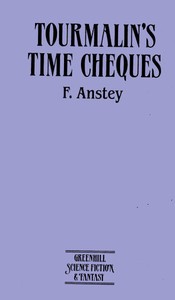
Tourmalin's Time Cheques — Edition Insights
(0 User reviews)
1188
Project Gutenberg
2014
Not confirmed
Time travel -- Fiction
Readers of public-domain and historical texts
Project Gutenberg digital edition
en
Edition facts
Words
37,135
Reading time
162 min
Text sections
5
The catalog record for Tourmalin's Time Cheques — Edition Insights provides practical reading context through 37,135 words, 2 hr 42 min estimated reading time, and 5 detected text sections.
The text analysis averages about 17.9 words per sentence, while the detected sections provide another way to judge how the source is divided.
Project Gutenberg metadata also associates the work with “Time travel -- Fiction,” connecting these edition facts with the source record’s subject description.
Source:
Project Gutenberg record #46173
In this 1885 comic novel, Peter Tourmalin receives time cheques that allow him to revisit past moments, but the excerpts show the system malfunctioning, leading to farcical misunderstandings and a threatened kicking from a bank manager.
Read the complete public-domain text at its original source.
Read on Project GutenbergF. Anstey's Tourmalin's Time Cheques (1885) presents time travel not as a grand adventure but as a bureaucratic farce. The protagonist, Peter Tourmalin, acquires cheques that let him draw on future time to revisit past moments—yet the system proves unreliable. In the excerpts, Peter finds himself abruptly shuttled between a drawing-room and a ship's dining-saloon, where he must improvise conversation with a bank manager who is furious about a scandal. The manager, Mr. Perkins, threatens to kick the originator of the gossip from one end of the ship to the other—unaware that Peter himself is the culprit. The comedy hinges on Peter's desperate attempts to maintain his cover while the time cheques keep betraying him.
The Bureaucratic Mechanics of Time Travel
The catalog subject "Time travel -- Fiction" suggests a straightforward speculative premise, but the excerpts reveal a distinctly bureaucratic mechanism. Peter receives "Time Cheques" that allow him to draw on future time, yet the process is mediated by a bank manager, Mr. Perkins, and involves a talisman and an oath. The system is prone to errors: Peter experiences a "chronological error" and finds himself in the wrong place at the wrong time. The cheques are treated as financial instruments, with terms like "account," "cheque," and "compound interest" applied to temporal transactions. This blend of commerce and time travel is central to the novel's humor, as Peter's attempts to manage his time account lead to increasingly absurd social predicaments.
Comic Misunderstandings and Social Anxiety
The excerpts showcase a comedy of errors rooted in social anxiety. Peter is repeatedly caught in lies he must maintain. When Perkins complains about a scandal, Peter feigns ignorance, even though he is the source. The threat of physical violence—"I'll kick him from one end of the ship to the other"—hangs over him, and Peter nervously notes Perkins's "strong, suitable boots." The humor derives from Peter's internal panic contrasted with his outward composure. He must navigate conversations where every word could expose him. The old woman who knows the truth adds another layer of threat. Anstey uses dialogue to reveal character: Perkins's bluster, Peter's evasions, and the constant risk of discovery create a tight, farcical structure.
Narrative Structure and the Unreliable Time Cheque
The table of contents reveals a carefully structured plot: a prologue, ten chapters, and an epilogue, with chapter headings that promise escalating complications. The excerpts come from a later chapter where the time cheques have already caused trouble. The narrative shifts abruptly between settings—from a music-room to a dining-saloon—mirroring the disorienting effect of the cheques. Peter's internal monologue shows his confusion: he "felt a twinge" and decides not to allude to the faulty cheques. The story does not explain the mechanics fully; instead, it focuses on consequences. This structural choice emphasizes the comic fallout over the speculative premise, making the novel more a social satire than a rigorous time-travel tale.
Readers should pay close attention to the chapter headings, which function as a comic roadmap. The novel rewards those who track Peter's escalating lies and the cheques' unpredictable effects. Anstey's strength lies in dialogue and situation, not in explaining the time-travel system. Approach the book as a Victorian farce about the perils of trying to cheat time—and the social consequences of getting caught.
That afternoon, the rain kept time against the window while Tourmalin’s cheques misfired gloriously, each slip landing him in embarrassment rather than memory. It made me think of endings, not beginnings—how chaos hums beneath order. Later, I found myself reaching for Omega: The Last days of the World — A Reader’s Guide, almost without deciding to, and the rain felt like a closing chapter.
There are no reviews for this eBook.
There are no comments for this eBook.
Reader reflection
Before you leave, reflect on the book
Use these questions to collect your thoughts before moving on.
Your progress
0
/
10
2
How did the book work for you overall?
3
Would you pass this book on to a friend?
4
How demanding did the text feel?
5
Would you read this book again?
6
Did the story or argument move comfortably?
7
How original did the book feel?
8
How useful were the ideas in this book?
9
What is the main idea you are taking away?
10