1

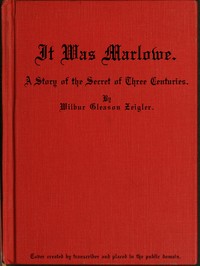
It Was Marlowe: A Story of the Secret of Three Centuries — Story, Setting & Ideas
(0 User reviews)
114
Project Gutenberg
2018
Not confirmed
Shakespeare, William, 1564-1616 -- Authorship -- Marlowe theory; Marlowe, Christopher, 1564-1593 -- Authorship; Marlowe, Christopher, 1564-1593 -- Fiction
Readers of public-domain and historical texts
Project Gutenberg digital edition
en
Edition facts
Words
74,595
Reading time
325 min
Text sections
10
This digital edition of It Was Marlowe: A Story of the Secret of Three Centuries — Story, Setting & Ideas is described by source-level measurements including 74,595 words, 5 hr 25 min estimated reading time, and 10 detected text sections.
The text analysis averages about 18.4 words per sentence, while the detected sections provide another way to judge how the source is divided.
Project Gutenberg metadata also associates the work with “Shakespeare, William, 1564-1616 -- Authorship -- Marlowe theory,” connecting these edition facts with the source record’s subject description.
Source:
Project Gutenberg record #57810
Zeigler's 1895 novel imagines Christopher Marlowe faking his death to write Shakespeare's plays, blending historical speculation with adventure. The narrative shifts between Marlowe's secret life and the pursuit of justice, using Marlowe's own verse as chapter epigraphs.
Read the complete public-domain text at its original source.
Read on Project GutenbergWilbur Gleason Zeigler's It Was Marlowe (1895) opens with a preface that establishes its central conceit: the author, having read Marlowe's plays as a boy, later became convinced that Marlowe—not Shakespeare—wrote the works attributed to the Stratford man. The novel then dramatizes this theory, following Marlowe after his supposed death in Deptford. Zeigler uses Marlowe's own lines as chapter epigraphs, pairing them with quotations from Shakespeare to suggest a single authorial voice. The narrative voice is earnest and scholarly, but the pacing varies: early chapters move deliberately through conspiracy, while later ones accelerate into chase sequences and courtroom drama.
Voice and the Marlowe-Shakespeare Link
The novel's most distinctive feature is its use of paired epigraphs. Each chapter opens with a line from Marlowe and one from Shakespeare, implying continuity. For instance, the preface quotes Tamburlaine and King John side by side. This technique extends into the narrative, where characters occasionally speak in blank verse or echo the playwrights' phrasing. Zeigler's own prose, however, is straightforward and descriptive, rarely rising to the poetic heights it invokes. The effect is a deliberate contrast: the lofty epigraphs set a tone that the text itself does not always sustain, creating a tension between the author's ambition and his execution.
Pacing and the Mechanics of Secrecy
The story's pace shifts markedly between its two main threads: Marlowe's hidden life and the legal pursuit of his supposed killer. Early chapters, such as 'The Meeting in Finbury Fields,' unfold slowly, with careful attention to setting and dialogue. Later chapters, like 'The Ride to Tyburn,' accelerate into action. A key scene in 'Where Lamentation Prevailed' shows constable Gyves following a plague cart through London streets; the prose here becomes almost cinematic, tracking his movements with precise detail. This shift from deliberation to urgency mirrors Marlowe's own predicament—the need to remain invisible while the world closes in.
Setting and the Texture of Elizabethan London
Zeigler grounds his speculative plot in concrete physical details. The novel describes a 'mediæval portable wardrobe' with a hidden shaft, 'gloomy looking buildings' at street corners, and 'rows of small, miserable cottages' with wooden fronts and reed roofs. These details are not merely decorative; they serve the plot, as when Tamworth uses a dumb waiter to signal for food. The plague adds a layer of urgency: bodies are carted away, and characters fear contagion. This attention to the material world—the mud, the narrow lanes, the fear of disease—gives the historical setting a palpable weight, even as the central premise remains fantastical.
Readers should note that Zeigler's novel is a work of fiction, not a scholarly argument. The appendix mentioned in the table of contents is not included in this digital edition, so the author's full case for the Marlowe theory remains incomplete. Approach the book as a period piece—a late-Victorian attempt to solve a literary mystery through imagination rather than evidence. The pacing rewards patience: the early chapters build a world, while the later ones deliver the chase.
There’s something about Zeigler’s Marlowe, that quiet spectacle of a life lived twice, which leaves me thinking of the sea-soaked perils in The Middy and the Moors: An Algerine Story — A Closer Reading. Both feel like secret histories, where the real adventure isn’t the chase itself, but the lingering shadow of who we might have been, had fate blown differently.
There are no reviews for this eBook.
There are no comments for this eBook.
Reader reflection
Record your reading impressions
A brief reflection can help important ideas stay with you longer.
Your progress
0
/
10
2
What was your overall reaction to the book?
3
Would you encourage someone else to read it?
4
How much effort did this book require?
5
How strongly did the book affect you emotionally?
6
How did the reading compare with what you expected?
7
How valuable was this book for your own interests?
8
Was the book moving at the right speed?
9
In one sentence, what did you learn?
10