1

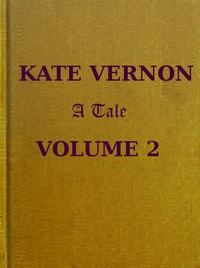
Kate Vernon: A Tale. Vol. 2 (of 3) — Inside the Classic
(0 User reviews)
346
Project Gutenberg
2016
Not confirmed
Fiction
Readers of public-domain and historical texts
Project Gutenberg digital edition
en
Edition facts
Words
51,004
Reading time
222 min
Text sections
10
The catalog record for Kate Vernon: A Tale. Vol. 2 (of 3) — Inside the Classic provides practical reading context through 51,004 words, 3 hr 42 min estimated reading time, and 10 detected text sections.
The text analysis averages about 22.3 words per sentence, while the detected sections provide another way to judge how the source is divided.
Project Gutenberg metadata also associates the work with “Fiction,” connecting these edition facts with the source record’s subject description.
Source:
Project Gutenberg record #53356
In Volume 2 of Mrs. Alexander's 1854 novel, Kate Vernon navigates music lessons, self-command, and quiet domestic life after Captain Egerton's departure, as revealed through precise observations of her character and interactions.
Read the complete public-domain text at its original source.
Read on Project GutenbergVolume 2 opens with Kate Vernon reflecting on Captain Egerton's departure, noting how closely he had linked himself with the pleasures and occupations of her secluded circle. The narrator explicitly states that Kate's regrets did not border on the sentimental, and she missed his figure and face without romantic attachment. This direct characterization sets a tone of psychological realism, as Kate's inner life is parsed through small, concrete details—her grandfather's daily remarks, her eye for beauty, and her view of marriage as a distant possibility.
Kate's Self-Command Under Scrutiny
During a music examination with Herr Hermann, Kate experiences a moment of intense anxiety: her memory clouds, the room swims, and the only distinct image she perceives is Hermann's severe critical look. Yet she recovers by pressing her hands to her eyes and conjuring the organist's pale, benevolent face from her old cloistered home. The narrator observes that Kate was making rapid strides in acquiring self-command, without which the empire of the world is but a wider range for the sceptred slave. This passage reveals how the novel uses internal struggle to dramatize character growth, tying Kate's composure directly to her musical performance.
The Music Lesson as Social Negotiation
Hermann's teaching session blends artistic instruction with practical advice on earning a living. He suggests Kate could make money by playing at private concerts, citing her figure and face, but Kate physically recoils, holding up her hand to repel the idea. The scene includes specific details: Hermann devours veal pie and pickled cabbage, mentions the old Duchess of L—— as a sharp client, and asks Kate to harmonize a simple air in four parts. These details ground the lesson in the material realities of a 19th-century musician's life, while Kate's refusal of public performance hints at class or propriety constraints.
Catalog Subjects Versus Actual Content
The Project Gutenberg record classifies Kate Vernon under Fiction and the category Exploration, Survival & Adventure Tales. However, the excerpts from Volume 2 show no exploration or survival elements. Instead, the narrative focuses on domestic routine, music study, and psychological introspection. Kate's world is a secluded circle of study, walks with her grandfather, and visits to the sick and needy. The only hint of adventure is the departure of a soldier, Captain Egerton, which creates a blank but not a plot. Readers expecting wilderness or peril will find a quiet character study instead.
The excerpts reveal a novel more concerned with interior states than external action. Kate's musical triumph and her negotiation with Hermann over public performance suggest tensions between artistic ambition and social propriety. Readers should attend to how the narrator's direct commentary shapes our understanding of Kate's emotions, and how small gestures—like holding up a hand to repel an idea—carry significant weight in this restrained world.
Reading Kate Vernon again, I found myself lingering over her quiet instruction in self-command, the way her music lessons become a small discipline of feeling. It reminded me, strangely, of an old study I once leafed through, The Flourishing of Romance and the Rise of Allegory (Periods of European Literature, vol. II) — Text and Context, where every passion is filtered through symbol. Both books seem to whisper that restraint is its own kind of story.
There are no reviews for this eBook.
There are no comments for this eBook.
Reader reflection
What was your reading experience?
Capture what you thought, learned, and would like to remember.
Your progress
0
/
10
2
How much did you enjoy the reading experience?
3
Would you pass this book on to a friend?
4
How demanding did the text feel?
5
Did the book give you something worth debating?
6
Do you expect to return to this book?
7
Which element worked best for you?
8
Was the book moving at the right speed?
9
What did this book teach you most?
10