1

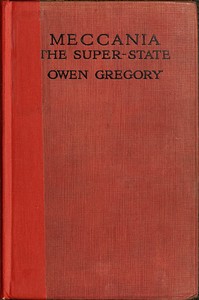
Meccania, the Super-State — Key Ideas to Explore
(0 User reviews)
452
Project Gutenberg
2013
Not confirmed
Dystopias -- Fiction
Readers of public-domain and historical texts
Project Gutenberg digital edition
en
Edition facts
Words
76,332
Reading time
332 min
Text sections
7
The catalog record for Meccania, the Super-State — Key Ideas to Explore provides practical reading context through 76,332 words, 5 hr 32 min estimated reading time, and 7 detected text sections.
The text analysis averages about 18.5 words per sentence, while the detected sections provide another way to judge how the source is divided.
Project Gutenberg metadata also associates the work with “Dystopias -- Fiction,” connecting these edition facts with the source record’s subject description.
Source:
Project Gutenberg record #44074
An editorial note on Owen Gregory's 1918 dystopian novel, focusing on the author's choices in diction, dialogue, and description as seen in excerpts from the narrator's journal about the super-state Meccania.
Read the complete public-domain text at its original source.
Read on Project GutenbergOwen Gregory's Meccania, the Super-State (1918) presents itself as a transcribed journal by a Chinese observer, Ming Yuen-hwuy, who tours a hyper-organized nation. The framing device—an editor who cannot vouch for Ming's credibility—immediately distances the narrative from straightforward reportage. Gregory's diction in the introduction is deliberately cautious: the editor notes that Ming 'professed a great admiration for our British Constitutions,' hinting at a possible satirical lens. The excerpts reveal a voice that oscillates between wonder and unease, as when the narrator describes factories where 'the men all marched in step, as if on parade.' This blend of admiration and mechanical imagery sets the tone for a work that examines efficiency at the cost of individuality.
The Observer's Voice and the Framing Device
The journal format allows Gregory to filter Meccania through a foreigner's perspective, but the editor's preface undercuts reliability. Ming is described as having 'a remarkable knowledge of our language' and 'familiarity with our laws,' yet the editor cannot 'go bail for Mr. Ming.' This ambiguity invites readers to question whether Ming's observations are accurate or ironic. In the excerpts, Ming's tone is often deferential—he calls the industrial system 'quite marvellous'—but his questions reveal skepticism. For instance, when Conductor Lickrod explains that capitalists retain motivation through 'promotion to a higher grade,' Ming's query 'But what motive have they for displaying enterprise?' suggests a gap between official rhetoric and human reality. Gregory uses this dialogue to expose the system's logic without overt condemnation.
Diction of Control and Mechanization
Gregory's word choices consistently emphasize order and uniformity. The house-building industry uses 'stereotyped' plans, with 'some forty or fifty different plans, all worked out to the minutest detail.' The term 'stereotyped' connotes both efficiency and rigidity. Similarly, work schedules are staggered to avoid 'congestion,' and workers salute with a motion 'raised to the shoulder only' to prevent contact. The Meccanian language includes a word for 'the adaptation of the means to the end,' which Lickrod claims has no equivalent elsewhere—implying that the culture itself is defined by this principle. Gregory's description of factories as having 'marvellous order and cleanliness and perfect discipline' uses positive adjectives that, in context, feel chilling. The repetition of 'marvellous' by both Ming and Lickrod underscores a shared vocabulary that masks underlying control.
Dialogue as a Tool for Exposition and Critique
The conversations between Ming and officials like Conductor Lickrod serve dual purposes: they explain Meccania's structure while subtly undermining it. Lickrod's speeches are filled with bureaucratic jargon—'fundamental principles of our Meccanian policy,' 'National Economy,' 'Meccanian spirit'—that parodies state ideology. When Ming asks about the role of capitalists, Lickrod's reply enumerates motives: 'Their livelihood depends upon the profits made; their promotion to a higher grade... also depends upon their skill and enterprise.' The repetition of 'depends' and the phrase 'for the sake of Meccanian Culture' reveal a system where every action is tied to advancement. Gregory's dialogue often ends with Ming's polite but pointed questions, such as 'But what motive have they for displaying enterprise?' which Lickrod answers with a cascade of justifications, leaving the reader to sense the hollowness.
Recurring Details: The Salute, the March, and the Meal
Gregory seeds the excerpts with small, recurring details that build a picture of total organization. The workers' salute—'the hand was raised to the shoulder only'—is a minor but telling modification to avoid 'a sweeping motion.' This attention to bodily control extends to marching: 'On leaving the works the men all marched in step, as if on parade.' Even the midday meal is regimented, taken 'by relays' from 11:30 to 1:30, with women employed in canteens spending 'the rest of their time in household work.' These details, presented without comment by Ming, accumulate to suggest a society where every moment is scheduled. The fact that Lickrod calls attention to the staggered start times as a 'triumph of organisation' highlights how Meccania values efficiency over individual preference. Gregory's descriptive restraint—letting the facts speak—makes the system's creepiness emerge from accumulation rather than editorializing.
Readers approaching Meccania, the Super-State should attend to the gap between what Ming reports and what he seems to feel. Gregory's authorial choices—the unreliable framing, the clinical diction, the dialogue that reveals ideology through repetition—create a work that critiques utopian efficiency from within. The excerpts offer no resolution, only a steadily mounting sense of unease. Treat Ming's journal as a document to be read against the grain, noting where admiration may mask irony.
Years among the stacks taught me that some books share a whispered secret. Meccania’s grim machinery, its clockwork citizens, always reminded me of the Tailor’s frightened mice—both worlds where small hearts endure vast, indifferent systems. One chills, the other warms, yet both know the loneliness of being tiny. A curious kinship, that. The Tailor of Gloucester — Themes and Context holds that softer echo.
There are no reviews for this eBook.
There are no comments for this eBook.
Reader reflection
Take a moment to reflect on this book
Create a short personal record of your experience with this book.
Your progress
0
/
10
2
How did the book work for you overall?
3
Would you encourage someone else to read it?
4
How demanding did the text feel?
5
How understandable was the text?
6
Did the book give you something worth debating?
7
Which element worked best for you?
8
How would you rate its originality?
9
Which lesson or insight stayed with you?
10