1

The Gnome King of Oz — A Reader’s Guide
(0 User reviews)
2078
Project Gutenberg
2023
Not confirmed
Oz (Imaginary place) -- Juvenile fiction; Fantasy fiction
Readers of public-domain and historical texts
Project Gutenberg digital edition
en
Edition facts
Words
42,923
Reading time
187 min
Text sections
26
For The Gnome King of Oz — A Reader’s Guide, the stored edition analysis reports 42,923 words, 3 hr 7 min estimated reading time, and 26 detected text sections.
The text analysis averages about 16.7 words per sentence, while the detected sections provide another way to judge how the source is divided.
Project Gutenberg metadata also associates the work with “Oz (Imaginary place) -- Juvenile fiction,” connecting these edition facts with the source record’s subject description.
Source:
Project Gutenberg record #71273
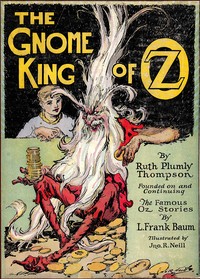
Ruth Plumly Thompson's 1927 Oz novel follows Ruggedo's escape from Runaway Island, Peter from Philadelphia, and the Patchwork Girl Scraps through a patchwork kingdom, a treasure ship, and a magic cloak, with wordplay and whimsical peril.
Read the complete public-domain text at its original source.
Read on Project GutenbergRuth Plumly Thompson opens The Gnome King of Oz with a direct address to readers, framing the story as a follow-up to Betsy's adventures and a radiogram from the Emerald City. The narrative voice is chatty and self-aware, promising "the most unexpected and mysterious happening yet" and listing a treasure ship, a new boy from Philadelphia, a magic cloak, and an Oztrich. This preface establishes Thompson's playful tone and her willingness to acknowledge the series' conventions while introducing fresh elements.
Patchwork Politics and Quilty Customs
Thompson invents a kingdom that literalizes its name: Queen Cross Patch rules a country that looks "like a huge patch-work quilt" from above. The Quilties—subjects named Scrapper, Piecer, and the Scissor Bird—enforce labor with scissors and sewing. The Patchwork Girl Scraps, herself a patchwork creation, is forced to cook and mend, a ironic reversal of her usual free-spirited role. The dialogue reveals a rigid social hierarchy: Scrapper addresses Peter as "Slave" and orders breakfast, while Scraps protests by invoking Ozma's leisure. Thompson uses these details to build a setting where domestic tasks become instruments of control, and where the patchwork motif extends from landscape to governance.
Wordplay and Inventive Threats
Thompson's diction leans into puns and whimsical threats. The Scissor Bird makes "playful snips at her yarn," and Scraps retorts "Oh scrapple!" when ordered to cook. Peter learns that "eggs are poison to gnomes," a detail that turns a breakfast staple into a weapon. The author also introduces a "magic cloak" and a "treasure ship" as plot devices, but the excerpts show her more interested in the texture of language than in elaborate mechanics. Characters speak in exclamations and rhymes: Scraps declares "Stop! Stop!" and Grumpy the bear offers to help with a yawn. This verbal energy keeps the prose buoyant even during captivity scenes.
Peter's Pragmatic Perspective
Peter, a boy from Philadelphia, serves as a reader surrogate. He asks practical questions—"How is it that Grumpy can talk?"—and takes charge of cooking when Scraps proves "terribly unhandy." His camping experience lets him fry eggs and set tables, grounding the fantasy in mundane competence. Thompson contrasts his matter-of-factness with Scraps's theatrical worry: while she frets about Ruggedo turning Ozma into a canary, Peter wrinkles his brows and pockets Kuma's note. This dynamic creates a low-key partnership, with Peter's curiosity about the Cowardly Lion and Hungry Tiger hinting at the wider Oz lore he has yet to encounter.
Voice and Narrative Framing
Thompson's authorial voice intrudes directly in the preface, addressing "Boys and Girls" and signing off with a rhyme: "I'm looking for letters. Looking right your way!" This frame recalls L. Frank Baum's own prefaces but adds a personal, almost epistolary quality. The dedication to her nephew "Little Dick" reinforces the intimate tone. Within the story, Thompson uses third-person narration that shifts between Scraps's exclamations and Peter's observations. Dialogue carries much of the characterization: the Scissor Bird's shrill commands, Grumpy's laconic offers, and Scraps's rhyming complaints all distinguish speakers without lengthy description. The result is a brisk, voice-driven narrative that prioritizes interaction over exposition.
Readers approaching The Gnome King of Oz will find a story that rewards attention to its verbal play and invented customs. Thompson builds on Baum's framework but stamps the narrative with her own idioms—patchwork kingdoms, scissor-wielding birds, and eggs as anti-gnome weapons. The excerpts suggest a book that moves quickly through episodes, with Peter and Scraps as a resourceful pair. For those familiar with Oz, the cameos and references will add depth; for newcomers, the brisk dialogue and clear stakes offer an easy entry point.
There’s something about that old Oz tale—Ruggedo escaping, wordplay carrying the quiet peril—that stays with you, not the plot so much as its gentle, off-kilter warmth. I felt that same lingering pull after spending time with Andy Grant's Pluck — A Closer Reading. It’s less about what happens than how it hums afterward, like a faint, pleasant melody you can’t quite place.
There are no reviews for this eBook.
There are no comments for this eBook.
Reader reflection
Before you leave, reflect on the book
Use these questions to collect your thoughts before moving on.
Your progress
0
/
10
2
How did the book work for you overall?
3
Would you recommend this book to another reader?
4
What was the reading difficulty like?
5
How well did it match your expectations?
6
Did it raise ideas you would like to talk about?
7
Was the book easy to understand?
8
Would a second reading be valuable?
9
What changed or sharpened your thinking?
10