1

The Night of the Trolls — Themes and Context
(0 User reviews)
1147
Project Gutenberg
2016
Not confirmed
Science fiction
Readers of public-domain and historical texts
Project Gutenberg digital edition
en
Edition facts
Words
22,553
Reading time
99 min
Text sections
3
For The Night of the Trolls — Themes and Context, the stored edition analysis reports 22,553 words, 1 hr 39 min estimated reading time, and 3 detected text sections.
The text analysis averages about 12.3 words per sentence, while the detected sections provide another way to judge how the source is divided.
Project Gutenberg metadata also associates the work with “Science fiction,” connecting these edition facts with the source record’s subject description.
Source:
Project Gutenberg record #53132
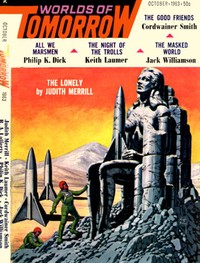
Keith Laumer's novella follows Jackson, a test subject who emerges from a controlled-environment tank to find his research facility abandoned, then navigates a post-apocalyptic landscape where rival factions vie for control of a Bolo war machine, with alliances shifting around a mysterious lighter.
Read the complete public-domain text at its original source.
Read on Project GutenbergKeith Laumer's The Night of the Trolls opens with a protagonist emerging from a controlled-environment tank into a disorienting silence. The physical symptoms—"a dry pain in my lungs," "wooden knives twisted in my chest"—are rendered with visceral precision, immediately establishing a body under stress. The empty laboratory, with its "tape reels empty" and "red equipment light off," signals that something has gone wrong beyond a routine test. This gap between expected procedure and stark reality drives the narrative forward.
The story's title hints at folklore, but the excerpts reveal a science-fictional landscape where a Bolo—a massive autonomous tank—has become a contested asset. The protagonist, Jackson, must piece together what happened while navigating a power struggle between the manipulative Mallon and the enigmatic Renada. A lighter engraved with the name of a dead commander becomes a clue, suggesting that the past is not as settled as it seems.
A Body in Crisis
The excerpts foreground physical discomfort as a narrative tool. Jackson's first-person account dwells on sensations: "my mouth tasted as though mice had nested in it," and he moves with "dizziness" and "shivering." This is not a hero in command; he is vulnerable, coughing and tripping over cables. The controlled-environment tank, meant to simulate conditions, has left him debilitated. Laumer uses this bodily distress to create immediacy and to question the reliability of Jackson's perceptions. When he notes that the equipment "had more bugs than a two-dollar hotel room," the colloquial voice contrasts with the sterile lab setting, grounding the science fiction in a recognizable, gritty perspective.
Objects as Evidence
Laumer invests ordinary objects with narrative weight. The lighter engraved "Lieut. Commander Don G. Banner, USAF" becomes a pivot point: Jackson finds it on Mallon's table, and its presence triggers a confrontation. The weather suit Jackson dons, the empty lockers, the rag-festooned coat hanger—each detail suggests a hasty departure or concealment. The Bolo itself, a war machine, is described through its absence: it cannot be approached due to a "spell" or command. These material clues invite the reader to assemble a story from fragments, much as Jackson must. The text rewards attention to what is seen and what is missing.
Shifting Alliances and Unstable Authority
The excerpts present a power triangle: Jackson, Mallon, and Renada. Mallon offers partnership but his wheedling tone—"I want to give you a break, share with you"—undermines his authority. Renada, initially silent, redirects her pistol from Jackson to Mallon, stating, "I'm also curious about how Commander Banner died." This reversal exposes the fragility of control. Jackson's dry retorts—"You hold the aces, Toby. Shooting me would be no trick at all"—show a protagonist who reads the room even when outgunned. The dialogue is taut, with characters speaking in short, clipped sentences that convey tension without exposition. The reader, like Jackson, must gauge whom to trust.
Readers should attend to the gaps in the narrative—the empty tape reels, the unexplained absence of the research team, the Bolo's mysterious lockdown. Laumer builds suspense through what is not said, and the lighter's inscription is a key that may unlock more than one secret. The story rewards careful attention to physical detail and dialogue subtext.
Sometimes I think about Jackson stepping out of that tank, how the silence of the facility must have felt heavier than any noise. It reminds me of the odd, quiet dread in The Tunnel Under the World, where a familiar morning hides something unshakably wrong. That sense of a world slightly tilted, where you can't quite trust your own senses, lingers long after the last page. There's a particular ache in that kind of loneliness, a wistfulness for a normalcy that never truly existed. Speaking of which, I revisited The Tunnel Under the World — Story, Setting & Ideas the other day, and it brought all that back.
There are no reviews for this eBook.
There are no comments for this eBook.
Reader reflection
What was your reading experience?
Capture what you thought, learned, and would like to remember.
Your progress
0
/
10
2
How did the book work for you overall?
3
Is this a title you would suggest to others?
4
What was the reading difficulty like?
5
Did this book create an emotional response?
6
Was the book moving at the right speed?
7
How clearly were the main ideas presented?
8
Would you start a conversation about this book?
9
In one sentence, what did you learn?
10