1

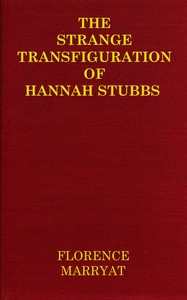
The strange transfiguration of Hannah Stubbs — Reading Notes
(0 User reviews)
156
Project Gutenberg
2025
Not confirmed
Spiritualism -- Fiction
Readers of public-domain and historical texts
Project Gutenberg digital edition
en
Edition facts
Words
84,230
Reading time
367 min
Text sections
8
For The strange transfiguration of Hannah Stubbs — Reading Notes, the stored edition analysis reports 84,230 words, 6 hr 7 min estimated reading time, and 8 detected text sections.
The text analysis averages about 16.8 words per sentence, while the detected sections provide another way to judge how the source is divided.
Project Gutenberg metadata also associates the work with “Spiritualism -- Fiction,” connecting these edition facts with the source record’s subject description.
Source:
Project Gutenberg record #76579
Florence Marryat's 1896 novel follows Hannah Stubbs, a working-class woman who marries a mysterious Italian professor and discovers his hidden aristocratic title. The excerpts reveal a tense marriage, class conflict, and Hannah's stubborn insistence on using her new rank, while the catalog subject 'Spiritualism' is not evident in the provided text.
Read the complete public-domain text at its original source.
Read on Project GutenbergThe novel opens with a brass plate reading 'Signor Ricardo, Prof. of the Italian Language' on a Soho lodging-house, immediately establishing a mystery around the tenant. Mrs. Battleby, the landlady, describes him as 'a Mystery' because he occupies the top rooms and keeps regular hours, yet his past is unknown. The narrative voice shifts between the landlady's colloquial speech and the professor's dignified manner, creating a contrast that sets up the central tension of hidden identity.
When Hannah Stubbs, the professor's wife, discovers a card reading 'Marchese di Sorrento' hidden in his drawer, she insists on being called 'my lady' despite their poverty. The dialogue reveals her determination to claim the title, while the professor pleads for discretion, fearing ridicule. This conflict between social aspiration and practical reality drives the early chapters.
The Mystery of Signor Ricardo
The first chapter introduces Signor Ricardo through the eyes of Mrs. Battleby, whose dialect-heavy narration paints him as an enigma: 'He’s as good a lodger as ever I had... but arter that—well! he’s a Mystery!' The description of his appearance—'tall, attenuated... dark-grey eyes, keen as those of a hawk'—and his poverty as an Italian refugee with confiscated estates establishes a romantic backstory. Yet the landlady's mundane concerns (regular payments, early lights-out) ground the mystery in everyday life. The narrative withholds Ricardo's true identity until Hannah's discovery, building suspense through small details like the locked drawer and the yellowed card.
Hannah's Claim to Rank
Hannah's reaction to discovering her husband's title reveals her character: she is obstinate, proud, and socially ambitious. She declares, 'If it’s your name, it’s mine too,' and immediately plans to demand respect from the grocer's wife. Her speech is marked by dropped h's and colloquialisms ('Like ’er impidence!'), contrasting with Ricardo's formal English. The argument over using the title exposes their class differences: Ricardo values dignity without display, while Hannah sees the title as a tool for social elevation. She even threatens to take her custom elsewhere if not addressed as 'my lady,' showing a practical, if naive, understanding of social power.
Poverty and Pretense
The excerpts highlight the couple's financial strain: Ricardo admits they have 'only enough money to live on,' and Hannah complains of doing housework that 'spoiling my complexion.' Yet she insists on keeping the title, asking, 'why should I be called out of my name?' The professor warns that no one will believe her story because of their humble circumstances. This tension between aspiration and reality is underscored by Hannah's cunning suggestion that she knows 'a way by which money could be made, and pretty sharp, too,' hinting at future schemes. The narrative thus sets up a conflict between the desire for status and the practical limitations of poverty.
Readers should note that the catalog subject 'Spiritualism' does not appear in the provided excerpts, which focus on domestic drama and class conflict. The novel may incorporate supernatural elements later, but the opening chapters ground the story in realistic social tensions. Pay attention to how Marryat uses dialect and detail to differentiate characters, and consider whether the 'transfiguration' of the title refers to Hannah's social transformation or something more literal.
That tense grip on a title, that stubborn insistence on rank—it reminded me how much of identity is a story we tell ourselves. Hannah’s restless hunger made me think of Tieck’s half-lit worlds, where the ordinary turns strange without warning. There’s a same ache in both, a longing that never quite settles. Tales From the "Phantasus," etc. of Ludwig Tieck — Background and Themes lingered with me for that very quiet reason.
There are no reviews for this eBook.
There are no comments for this eBook.
Reader reflection
Record your reading impressions
A brief reflection can help important ideas stay with you longer.
Your progress
0
/
10
2
What was your overall reaction to the book?
3
Would you pass this book on to a friend?
4
How easy was the book to follow?
5
Did the book give you something worth debating?
6
How distinctive were its ideas or approach?
7
Did the book meet your expectations?
8
Which element worked best for you?
9
In one sentence, what did you learn?
10