1

Dead letters — Key Ideas to Explore
(0 User reviews)
90
Project Gutenberg
2023
Not confirmed
English wit and humor; Imaginary letters; English fiction -- 20th century; Letters in literature
Readers of public-domain and historical texts
Project Gutenberg digital edition
en
Edition facts
Words
52,706
Reading time
230 min
Text sections
30
The catalog record for Dead letters — Key Ideas to Explore provides practical reading context through 52,706 words, 3 hr 50 min estimated reading time, and 30 detected text sections.
The text analysis averages about 20.5 words per sentence, while the detected sections provide another way to judge how the source is divided.
Project Gutenberg metadata also associates the work with “English wit and humor,” connecting these edition facts with the source record’s subject description.
Source:
Project Gutenberg record #71285
A collection of imagined letters from historical and literary figures, blending humor and anachronism. Baring's preface warns against taking them as historical documents, yet one letter is composed entirely of factual grains. The excerpts show Lady Macbeth writing about her husband's hallucinations and a player describing Hamlet's court.
Read the complete public-domain text at its original source.
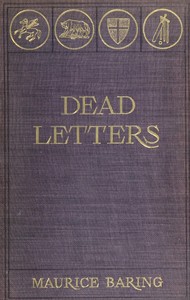
Read on Project GutenbergMaurice Baring's Dead Letters collects letters originally published in the Morning Post, each purporting to be from a historical or literary figure. The author's preface immediately establishes a playful stance: he calls the letters "fruits of imagination rather than research" and admits to relying on "hazy memories" and a "few hurried references." Yet he also claims that "amidst this chaff of fancy there are a few grains of historical truth." This tension between irreverent invention and buried fact shapes the entire work.
The two excerpts provided—Lady Macbeth's letter to a friend and a player's account of Hamlet's court—show Baring's method. He takes well-known characters and reimagines their private voices, often with comic effect. Lady Macbeth's domestic anxieties about her husband's "hallucinations" invert the tragedy's drama, while the player's letter presents a sane, courteous Hamlet trapped by courtiers who call him "deranged."
Domesticating Tragedy: Lady Macbeth's Household Voice
In the excerpt from Lady Macbeth's letter, Baring transforms a tragic queen into a worried hostess. She writes to "dear Flora" about Macbeth's "terrible delusion" that he killed Duncan. The language is that of a society lady managing a crisis: "Fortunately, nobody has noticed it." She frets about gossip, saying "people are so spiteful that somebody is sure to start the rumour that it's true." The postscript—"Don't forget to bring Jeamie. It will do Macbeth good to see a child in the house"—is a masterstroke of bathos. Baring does not mock the original story but rather shows how a domestic perspective can deflate grand tragedy into social embarrassment. The letter's tone is consistent: worried, practical, and utterly unaware of the irony.
The Player's Perspective: Hamlet as a Patron
The second excerpt offers a different kind of defamiliarization. A traveling player describes Hamlet as a courteous, portly prince who "seemed but little changed" from his student days. The player notes that Hamlet's love for "well turned verse" and "the nice declamation of noble lines" remains ardent. The court, however, treats him as deranged if he transgresses etiquette. Baring here gives voice to a minor character, one who sees Hamlet not as a tragic hero but as a knowledgeable patron. The player's matter-of-fact tone—calling The Murder of Gonzago "a somewhat old-fashioned bit of fustian"—contrasts sharply with the play's own high drama. This shift in perspective reveals how Baring uses the letter form to explore the gap between public reputation and private reality.
The Author's Game: Truth and Invention
Baring's preface is itself a key part of the book's design. He challenges readers to identify which letter is "entirely composed" of historical grains, noting that one such letter has already been singled out by experts as the most improbable. He also mentions that correspondents asked for more details about Lady Macbeth's housekeeping and Lord Bacon's business affairs—suggesting that some readers took the letters as genuine. Baring's tone is wry: he says he has "suffered more from the credulity than from the scepticism of my readers." This meta-commentary invites the reader to approach each letter with a detective's eye, looking for the factual needle in the fictional haystack. The preface thus functions as a playful contract between author and reader.
Diction and Voice: The Social Register
Across both excerpts, Baring's diction is carefully chosen to match the supposed writer's social station. Lady Macbeth's letter uses the language of a Victorian lady: "I am in a terrible position," "I beg you, dear Flora, to keep all this to yourself." The player's letter is more professional, with phrases like "we spent the day in study and rehearsal" and "the Prince overruled their objections." Baring avoids archaic speech, instead giving his characters a contemporary (early 20th-century) idiom that makes them feel familiar. This anachronism is deliberate: it underscores the letters' status as imaginative exercises rather than historical reconstructions. The result is a collection that feels less like a museum and more like a gossip column from another time.
Readers will find that Dead Letters rewards attention to its framing. Baring's preface is not mere throat-clearing but a clue to the book's method. Each letter asks to be read on two levels: as a character sketch and as a puzzle about historical truth. The pleasure lies in spotting the anachronisms, the buried facts, and the author's sly humor. Approach the collection as a game of literary detection, and the letters will yield more than their surface comedy.
Leafing through Baring’s invented letters again, I kept thinking of how they weigh rumor against fact, much like Brandes does when untangling a century’s moods. There’s a particular tenderness in treating ghosts as people, whether Lady Macbeth or a French satirist. It reminded me of Main Currents in Nineteenth Century Literature - 3. The Reaction in France — A Reader’s Guide, where every voice feels like a half-remembered conversation, not a lesson.
There are no reviews for this eBook.
There are no comments for this eBook.
Reader reflection
What was your reading experience?
Capture what you thought, learned, and would like to remember.
Your progress
0
/
10
2
Did this book hold your interest?
3
Would you recommend this book to another reader?
4
How demanding did the text feel?
5
How strong was your personal connection to the text?
6
Did any part of the book stay with you emotionally?
7
How useful did the reading feel?
8
Was the book easy to understand?
9
In one sentence, what did you learn?
10