1

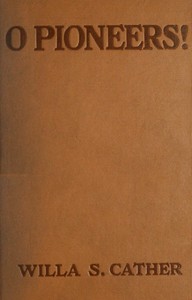
O Pioneers! — Themes and Context
(0 User reviews)
2288
Project Gutenberg
2008
Not confirmed
Nebraska -- Fiction; Historical fiction; Frontier and pioneer life -- Nebraska -- Fiction; Domestic fiction; Siblings -- Fiction; Farm life -- Fiction; Women pioneers -- Fiction; Women farmers -- Fiction; Women immigrants -- Fiction; Swedish Americans -- Fiction
Readers of public-domain and historical texts
Project Gutenberg digital edition
en
Edition facts
Words
60,326
Reading time
263 min
Text sections
32
The catalog record for O Pioneers! — Themes and Context provides practical reading context through 60,326 words, 4 hr 23 min estimated reading time, and 32 detected text sections.
The text analysis averages about 14.7 words per sentence, while the detected sections provide another way to judge how the source is divided.
Project Gutenberg metadata also associates the work with “Nebraska -- Fiction,” connecting these edition facts with the source record’s subject description.
Source:
Project Gutenberg record #24
Willa Cather's novel follows Alexandra Bergson, a Swedish immigrant girl who transforms a harsh Nebraska prairie into a prosperous farm. The story contrasts her steady determination with the restless yearnings of her brother Emil and the tragic love of their neighbor Marie. Cather's prose shifts from stark winter landscapes to lyrical spring, mirroring the characters' inner lives.
Read the complete public-domain text at its original source.
Read on Project GutenbergThe opening chapter of O Pioneers! immediately establishes a landscape that resists human habitation. Hanover, Nebraska, is described as a town “trying not to be blown away,” its buildings “huddled” on the prairie under a gray sky. The snow is “curling and eddying,” and the wind blows under the houses as well as over them. This is not a welcoming frontier; it is a place of harsh, elemental forces. Cather’s prose here is precise and unadorned, matching the starkness of the setting. The only human figure in this opening scene is a five-year-old boy crying bitterly on the sidewalk, his oversized coat making him “look like a little old man.” This image of vulnerability against an indifferent landscape sets the tone for the novel’s exploration of endurance and loss.
The Weight of the Land
The novel’s first part, “The Wild Land,” is dominated by descriptions of the prairie that emphasize its heaviness and silence. The opening poem speaks of “The miles of fresh-plowed soil, / Heavy and black, full of strength and harshness.” This weight is not merely physical; it carries emotional and psychological implications for the characters. Alexandra Bergson, the central figure, is introduced as a young girl who “had a serious face” and who “was always thinking.” Her connection to the land is immediate and intuitive. When her father dies, she takes over the farm, and the narrative shifts from the oppressive winter to the promise of spring. The land becomes a character in its own right, its moods dictating the pace of the story. Cather’s descriptions of the prairie are never merely scenic; they are integral to the novel’s emotional architecture.
Voices of the Community
While the land is a constant presence, the novel’s human voices provide contrast and texture. The dialogue among the Swedish and French settlers is rendered with a keen ear for dialect and rhythm. In one scene, the French boys at a church fair speak in a lively, colloquial manner. Amédée, the newly married pitcher, boasts to Emil: “A married man don’t lose his head no more.” His speech is peppered with exclamations and gestures, creating a sense of communal energy. Emil, by contrast, is more reserved, his responses brief and often noncommittal. The exchange reveals not only character but also the social dynamics of the immigrant community. Cather uses these conversations to break the novel’s more meditative passages, creating a rhythm that alternates between interior reflection and external action.
Shifts in Pace and Mood
The novel’s structure is marked by deliberate changes in pace. The early chapters move slowly, dwelling on the landscape and the daily routines of farm life. The prose is measured, almost static, mirroring the characters’ struggle against the elements. As the story progresses, the pace quickens, particularly in Part IV, “The White Mulberry Tree,” where the narrative becomes more dramatic and event-driven. The shift is signaled by a change in setting: from the open prairie to the more enclosed spaces of the orchard and the house. The language becomes more urgent, with shorter sentences and increased dialogue. This acceleration creates a sense of impending crisis, contrasting sharply with the novel’s earlier, more contemplative tone. Cather’s control of tempo is one of the novel’s most striking features.
Recurring Motifs: Youth and the Prairie
Throughout the excerpts, youth appears as a fleeting, almost painful presence. The opening poem contrasts “Youth, / Flaming like the wild roses” against “the eternal, unresponsive sky.” This motif recurs in the character of Emil, whose restlessness and desire for something beyond the farm are evident in his interactions with Marie. The prairie itself is described as “always silent,” yet it is also the source of the novel’s most lyrical passages. Cather’s prose often shifts between the concrete and the poetic, as when she describes the “sullen fires of sunset” or the “sharp desire” of youth. These recurring images create a sense of continuity, linking the characters’ inner lives to the external world. The novel does not resolve the tension between youth and the land; instead, it holds them in balance.
O Pioneers! rewards attention to its shifts in tone and pacing. Readers may notice how Cather uses the landscape to mirror emotional states, and how the dialogue of the French and Swedish settlers adds texture to the narrative. The novel’s structure—alternating between expansive description and intimate conversation—creates a rhythm that is both deliberate and surprising. Pay particular attention to the way the seasons change, and how the characters’ fortunes rise and fall with them.
Reading O Pioneers! again, I found myself lingering on Alexandra’s quiet letters to Emil, so full of unspoken worry. That ache of messages that never quite reach their recipient stayed with me long after closing the book. It reminded me of a folder of old correspondence I once kept, and then of Dead letters — Key Ideas to Explore, which touches on similar silences. Some things are only heard in what remains unsaid.
There are no reviews for this eBook.
There are no comments for this eBook.
Reader reflection
Your personal reading reflection
Build a private reading journal entry for this title.
Your progress
0
/
10
2
How much did you enjoy the reading experience?
3
Would you encourage someone else to read it?
4
How demanding did the text feel?
5
Did the book deliver what you hoped for?
6
Did you gain anything practical from the text?
7
Is this a title worth rereading?
8
Did any part of the book feel personally relevant?
9
What changed or sharpened your thinking?
10