1

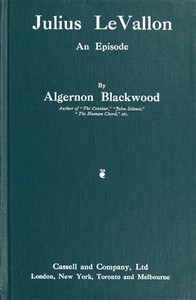
Julius LeVallon: An Episode — Reading Companion
(0 User reviews)
1785
Project Gutenberg
2015
Not confirmed
Reincarnation -- Fiction
Readers of public-domain and historical texts
Project Gutenberg digital edition
en
Edition facts
Words
111,897
Reading time
487 min
Text sections
40
Julius LeVallon: An Episode — Reading Companion can be approached with a clearer sense of reading commitment from its source measurements: 111,897 words, 8 hr 7 min estimated reading time, and 40 detected text sections.
The text analysis averages about 17.8 words per sentence, while the detected sections provide another way to judge how the source is divided.
Project Gutenberg metadata also associates the work with “Reincarnation -- Fiction,” connecting these edition facts with the source record’s subject description.
Source:
Project Gutenberg record #50107
Algernon Blackwood's novel traces the narrator's encounters with Julius LeVallon, a man who claims memories of past lives. The story moves from school days to Edinburgh and a Jura Mountains châlet, using recurring images of light, sleep, and nature to explore reincarnation.
Read the complete public-domain text at its original source.
Read on Project GutenbergThe novel opens with the narrator in Bâle, awaiting letters after a climbing holiday in the Dolomites. A letter from Julius LeVallon, bearing a Swiss stamp and covered in addresses, arrives and stirs immediate excitement. The narrative then shifts to their schooldays, establishing a pattern of memory and anticipation that governs the entire work.
Blackwood structures the story in four books—Schooldays, Edinburgh, The Châlet in the Jura Mountains, and The Attempted Restitution—each marked by a distinct setting and a deepening of the central mystery. The movement between these locations is not merely geographical; it mirrors the narrator's gradual awakening to Julius's claims of past lives and the strange, luminous atmosphere that surrounds him.
Recurring Images of Light and Sleep
Throughout the excerpts, light and sleep function as twin motifs that signal shifts in perception. The narrator wakes in the Jura châlet to “sunshine in a flood” and a “crisp air” that makes him feel “positively like a boy again.” This radiant morning follows a night of sleep during which “the heavier emotions had sunk to the bottom, the lighter had risen to the top.” Sleep becomes a threshold: it allows the narrator to shed dread and access a more vital, youthful state. The same pattern appears in the opening chapter, where the narrator recalls a climbing holiday interrupted by “impenetrable mists” and “furious autumn storms”—a kind of waking gloom that contrasts with the clarity of Julius’s letter. Blackwood uses these contrasts to suggest that ordinary consciousness is a fog from which Julius’s presence offers release.
The Châlet as a Walled Garden
The Jura châlet is described as a “secluded valley, walled-in from the blustering world like some wild, primitive garden.” This image of enclosure recurs in the narrator’s sense of being protected from ordinary time. The châlet’s interior is scented by pine woods, and the limestone cliffs a mile away are “of quite dazzling brilliance.” The setting is not just picturesque; it functions as a space where the laws of normal experience seem suspended. The peasant girl gathering vegetables, the “Dog-Man” who nosed about the room, and Julius himself all belong to this enchanted realm. The narrator’s feeling that “this lonely region of woods and mountain tops suggested the presence of some Nature Deity” reinforces the idea that the châlet is a sacred precinct, set apart for the revelation of hidden knowledge.
Movement Between Scenes and States of Mind
The novel’s structure depends on abrupt transitions between locations and mental states. The narrator moves from the Dolomites to Bâle, then to the châlet, and each shift is accompanied by a change in emotional weather. In the Dolomites, bad weather and “savage desolation” dominate; in Bâle, anticipation; in the châlet, a “joyful irresponsibility, as of boyhood.” These movements are not merely travelogue; they mirror the narrator’s inner journey from skepticism to openness. The epigraphs at the start of each book—quoting A.E., J. M’Taggart, and Stephen Phillips—further signal that the narrative is as much about philosophical inquiry as about plot. Blackwood uses the gaps between scenes to imply that what happens offstage—in sleep, in memory, in the spaces between chapters—is as important as what is shown.
Julius LeVallon as a Figure of Light and Memory
Julius is consistently associated with light and with the idea of remembered lives. When the narrator first sees him in the châlet, he “wore the glory of the morning in his eyes” and stood “erect in his mountain clothes” like a “proverbial Greek god.” The narrator’s immediate thought—“If she is of equal splendour!”—reveals that Julius’s presence evokes a female counterpart, though she does not appear in the excerpts. Julius’s speech is minimal in the provided text, but his effect on the narrator is profound: he makes the narrator feel “that one must live for ever.” The epigraph to Book I, “Dream faces bloom around your face / Like flowers upon one stem,” suggests that Julius carries the faces of many past lives. Blackwood does not explain this directly; instead, he lets the imagery of light, radiance, and morning accumulate around Julius, making him a symbol of continuity beyond death.
The Role of the Natural World
Nature in the excerpts is not a backdrop but an active participant. The stream “ran gaily,” the meadows “glistened,” and the mountains “wore a lustre as of life that ran within their solid frames.” This animism extends to the “Dog-Man,” whose behavior—nosing, sniffing, trotting—blurs the line between human and animal. The narrator’s bath in a forest pool, the peasant girl’s song, and the morning sunshine all contribute to a sense that the natural world is charged with meaning. Blackwood’s prose often personifies natural elements: the cliffs are “of quite dazzling brilliance,” and the pine woods “scented the whole interior.” This technique reinforces the novel’s theme that the material world is a veil for a deeper, spiritual reality. The narrator’s perception of nature shifts as he comes under Julius’s influence, suggesting that the landscape itself is a kind of memory.
Readers should pay attention to the epigraphs that open each book: they are not decorative but thematic keys. The novel’s title calls itself “An Episode,” implying that the events are a fragment of a larger, unseen whole. Blackwood’s method is to suggest rather than state, using recurring images of light, sleep, and enclosure to build a mood of expectancy. The gaps between the four books are as significant as the scenes themselves, inviting the reader to infer what lies beneath the surface of the narrative.
Sometimes, reading about LeVallon’s blurred edges—those airy insomnias where the past felt nearer than the present—I found myself thinking of letters that never reached their destination. There’s a similar stillness there, a sense of messages drifting just beyond the curtain. Dead letters — Key Ideas to Explore felt like that same quiet ache, a soft echo in an empty hallway.
There are no reviews for this eBook.
There are no comments for this eBook.
Reader reflection
Take a moment to reflect on this book
Create a short personal record of your experience with this book.
Your progress
0
/
10
2
How did the book work for you overall?
3
Is this a title you would suggest to others?
4
How easy was the book to follow?
5
Did this book create an emotional response?
6
How valuable was this book for your own interests?
7
How personally connected did you feel to the book?
8
Which part made the strongest impression?
9
In one sentence, what did you learn?
10